
This Post Will Get Me Fired
This is an intervention letter, not a list of grievances

“Shall man’s insatiate greed bind me to a constancy foreign to my character? This is my art, this the game I never cease to play. I turn the wheel that spins. I delight to see the high come down and the low ascend. Mount up, if thou wilt, but only on condition that thou wilt not think it a hardship to come down when the rules of my game require it.” — Lady Fortune, On the Consolation of Philosophy
Innovation turns the wheels of fortune in business. When businesses are low or the market is new, everyone believes that the wheels must turn in their favor — why else would you build something new if not to succeed where others have failed? But something funny happens when we reach the top of the wheel. Most of us believe that the wheel will finally cease turning.
We’ve settled into our comfy position as the (a?) market leader. We’ve become too large to react quickly and worry about “intermediation” and “commodification” while signing partnerships to “move faster.” At the top, we unironically talk about “not being too disruptive” and “not cannibalizing existing revenue” in strategy meetings. Someone declares we need to innovate; everyone nods and agrees… just not too fast and not right now.
Now is not that time — now never is. There are profits to be made, quarterly targets to achieve, and shareholders interests to consider. Innovating means potentially falling short or losing money. That’s the point of business, so we’re told, to maximize value for the shareholders.
The shareholders are the only winners in the recent Citrini Research post, “The Consequences of Abundant Intelligence”. The memo is a speculative look at what happens to an economy that outsources all critical thinking and investment capital into artificial intelligence. Citirini argues that the premium history has placed on human intelligence is going to disappear — much faster than we can adapt. When that premium disappears, humans need not apply.
In their future-dated macro memo, the date is June 30th, 2028. Unemployment is above 10.2% following massive layoffs in the tech and white collar industries. AI and its infinite capacity for work has taken the place of employees in most non-manual or service work. This was initially met with praise from shareholders who dreamed of what efficiency gains would do for profits.
I started reading the memo as I was getting ready for the gym. Five minutes in and I hadn’t moved. These two quotes engulfed my conscious thought:
“The systems of record were supposed to be safe.”
”The biggest way to repeatedly save the user money (especially when agents started transacting among themselves) was to eliminate fees. In machine-to-machine commerce, the 2-3% card interchange rate became an obvious target.”
This was the “oh no” moment for me. 20 minutes later, I was frenetic, incensed, inspired, and scared. I was pacing as I recorded a rambling voice note:
We all know this is a problem, right? Someone’s gotta tell them. I can’t sit back idly and watch as my industry gets disintermediated all while sitting on its hands and fighting for petty victories and ever compressing revenue streams…
Over half our industry is built off nothing but inertia — there’s a reason they call us “legacy” processors…
Legacy processors are already facing utility-like multiples compared to nimble software startups and insurgents. Rather than disrupt ourselves, we’ve spent the better part of two decades buying up every challenger, “raising and RIF-ing”, and leaning on comically expensive consultants to do our thinking — just like we’re all doing with AI…
In our worship at the altar of “line must go up”, we’ve created ever-larger conglomerates. We think that by consolidating and buying up the competition we can tamp the brakes of progress and keep the pace of innovation manageable… stay on top longer… Visa and Mastercard and a thousand others are quietly taking over, but, for now, just in specialized verticals and on periphery services. Things have to change.
If we don’t make meaningful changes to the ways legacy fintechs operate, somebody (or worse, a client) with a mac mini and a Claude subscription will disrupt us.
Then our hubris — our belief that migrating systems is “like open heart surgery” — will seal our fate. The toll booth we sit on is crumbling. We believe that we can lobby, litigate, and wait for this threat to pass. But I worry that we’re just going to be left with an empire of sand.
Human intelligence and ingenuity has long been the only solution to overcoming complexity. Commerce is perhaps the most complex system we humans have yet devised. Cross-border payments, settlement-availability lag, payment reconciliation — all of these are challenging to do even at modest scale and in the best cases. Our always on, truly global, and multi-modal world has only served to amplify the issues which have always made payments complex.
Complexity, not technology, has always been the real moat for finance and payment organizations.
It’s why banks, processors, and networks can charge such high interchange and processing fees, set the terms for payments, and earn income on float. The steady returns, high customer lock-in, and limited competition are why fintech has attracted so much investment over the past two decades.
We’ve generously rewarded the people and business (which are just collections of people) who solve for complexity . They get to be intermediaries that connect the financial world and establish tollgates. Those with the greatest domain knowledge of “how the sausage gets made” are held dearly within their organizations — they’re the only ones keeping the lights on.
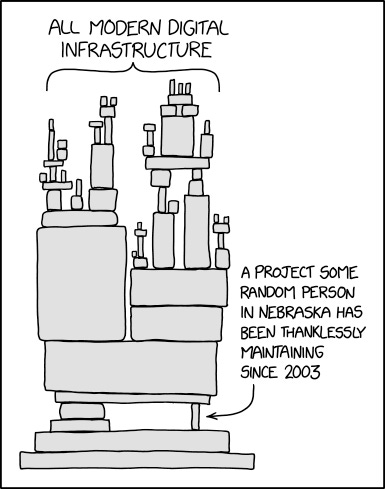
Besides the operational necessity, companies can’t afford to lose the “sausage makers” for another reason: if sent out into the wild, these are the same of the people who could most disrupt incumbents. They know the nuance of the industry and are the ones who have real ideas for disruptive innovation.
The best ones I’ve talked to dream of overhauling the system and starting from scratch. However, we all know the organization where they work couldn’t handle that kind of change — they can hardly stick to a 3 year roadmap because of annual planning and those go out the door in service of quarterly targets. Instead, their ideas get put in tech debt, backlog queues, or they’re told not to “rock the boat.”
So the idea sits idle in the office, because it’s long been too daunting for a new company to break into the industry. It takes time and capital on top of the regulations and legal challenges. The lag and societal norms — the employer-employee social contract — kept most sausage makers from leaving.
When they did leave, it was a notable event that shook an industry. In 1957, Shockley Semi was rocked when the “Traitorous Eight” left to found Fairchild Semiconductor. In 1968 Fairchild was similarly impacted when Andrew Grove and Leslie L. Vadász left to found Intel. These were rare and exceptional because product development and sales took immense amounts of time and capital.
The internet age saw development and distribution costs fall, frictions reduced and companies amended the social contract through frequent layoffs and RIFs — gotta make line go up!. The sausage makers were replaced by consultants who backfilled the lost institutional knowledge with 120-slide presentations full of platitudes and “vision” — we paid them a lot of money so it must be good advice!
Armed with this advice, legacy firms turned to a new tactic for the most important or recently acquired builders / potential disruptors. These individuals and teams were chained to the desk with a set of golden handcuffs and non-competes. Even as these have been relaxed, legacy firms still haven’t been worried… It’s not like one person would choose to take on a mega-corporation.
My brother, Thomas, is single-handedly (along with his Claude Code subscription) taking on Intuit with his startup Flowforth. He’s been working in and around church software for almost 20 years.1 After almost two decades volunteering at and working for churches — “making the sausage” — he’s developed a keen awareness for their nuances. In particular, he understood the challenges integrating with the largest church software company — Planning Center the Salesforce for churches. For years, Planning Center has only had one partner, Mailchimp, for email integration.2 But after decades of growth and being the go-to solution, they’re in a tough spot.
Mailchimp needs high-end features and leading CRM/ERP integrations to stay competitive in the market and integrate with Intuit’s large-scale clients. At the same time, they also need the long-tail of down-market clients to have a chance of meeting the double digit growth targets assigned to them by their parent company’s shareholders.3
The long-tail is the only real growth channel for Mailchimp. The top-of-market is dominated by in-house solutions or enterprise-grade solutions. However, they’ve alienated this core market with complex features and an expensive product.
My brother does not have this problem. He is laser focused on building features exclusively for churches. Churches are not like a pop-up boutique or a PTA, they are4 focused on faith formation and discipleship. As a result, he continues to grow 30% month over month and has burned through 3 billion tokens on Claude Code just this year.
Thomas built Flowforth to solve for the nuances of his niche that Mailchimp simply doesn’t have the time or focus to address. He had the development skills to set things up — this is his third startup attempt — but what finally flipped the switch was the superpower of AI assistants. “Every time I think I need to hire someone, I figure out a way to solve for it or a new AI feature drops.” Thought of another way, he and all the other solopreneurs don’t need extra headcount, just greater token count.
Crypto.com just laid off 12% of its workforce. Block laid off 40% the other week. Klarna has seen its workforce halve since 2022. They’re all citing AI as the primary catalyst. Technological change and disruption are advancing at rates that giant incumbents simply aren’t ready for. Rather than innovate and adapt ourselves, what are most legacy processors and networks doing?
We’re fighting card legislation in Congress. Some are threatening to cut off card processing in Illinois unless a judge overturns their recent interchange laws governing taxes and tips.5 Our industry giants are trying to pin the wheel of fortune and progress in place with the court rulings rather than taking real steps to move with the cycle of the market.
Meanwhile, interchange and high-processing fees — the lifelines for payment processing — are dying. We were facing pressures before agentic commerce made everyone realize that the world doesn’t have to be based on cards. India, Brazil, Kenya, and China have all shown what it looks like to leapfrog cards straight to account-to-account (A2A) payments. Real-time rails have been established in every major global market and crypto/stablecoin rails are eschewing geographic and regulatory constraints altogether.
Rather than take a sober look at our investments in cards, legacy batch processing, and security of “sticky” relationships, we’re announcing AI strategies and “agentic commerce” initiatives that are nothing more than marketing fluff. The innovative initiatives we are launching (and we are launching real products) are often priced or built so as not to cannibalize our existing revenues — we must avoid commodification! We’re stifling our own modernization and innovation efforts because our incentive structures reward it.
Frank Young shared a similar sentiment in his recent post “The Great Fintech Repricing.” He argues the market has already made its judgment about us: legacy processors are being repriced as utilities, not growth companies. Inside these companies, many sales plans and product roadmaps are still optimizing for “execution metrics” like keeping customers rather than keeping control. The gap between how we see ourselves and how the market sees us will only continue to grow unless we take steps to change it.
The winning processors in 2030 will embrace commodification at the transaction layer, because they know the real value has moved upstream. They’ll accept that transaction processing in an age of machine to machine payments is a race to zero margins and that public/democratized options will win in the long-run.
The successors to today’s leaders will look more like value-add service shops (Visa + Featurespace/Tink, Mastercard + Ethoca/BVNK, and Stripe’s BaaS play), best of breed/niche solution providers (Toast, Plaid, Flywire), or regulated API and orchestration layers (Pix, UPI, Rainforest) than “sticky” behemoths we have today.
The legacy players that survive will invest in sausage makers and skunk works. We stay alive by changing course, not by protecting broken valuations and replacing our best people with AI. Because that’s where the real value is… that’s where it always has been.
There are tens of thousands of people like Thomas out there — the real “sausage makers” with niche domain knowledge. If we don’t act, they’re the ones who will drain the moats completely dry. Then, they’ll be the ones storming the walls.
The wheel of fortune will continue to spin whether we want it to or not. The time to change is now. Now is never a good time, but trying beats watching the world leave you behind on your way down.
This is my art, this the game I never cease to play.
He’s 26, by the way, and I’m an immensely proud and impressed older brother. Thomas started reading the Bible and HTML books around age 7 and hasn’t looked back since. The grind is just hardwired into some people.
Mailchimp makes email and other marketing tools for a range of small and medium-sized businesses. The Intuit subsidiary has +1,200 employees and generated nearly $1.3 billion in revenue in 2025. It succeeded in becoming a widely recognized name, offering reliable, easy-to-use solutions that integrate into most CRMs, ERPs, and ecommerce platforms.
Intuit’s flagship product, TurboTax, is built on the complexity of the US tax system. They successfully killed the government’s online self-file option and buried their court mandated free file option in a sea of dark patterns.
…supposed to be…
Direct quote from senior industry operator.
Question if I may: what did you think of the Paxos fat-finger re:PayPal? In one move. PayPal was suddenly the largest B2B processor in the World. And then Paxos burned it all down... Instead of doing that they could have simply assigned the tokens to the largest multi- nationals on their roster and saved them so much money in processing and fees...for the mistake to look genius. I am curious about your take, if you don't mind sharing...
Yeah, I'm aware, but it was already a done, if in error, thing. If Paxos was so error prone, why did PayPal choose them in the first place?
And I'm also aware that you can't force change...but one of the most sure ways is to make a significant dent in the outgoing monies.
Near instant settlement for airplanes and other massive things might have been enough to sway a few folks who would otherwise hesitate.
Otherwise those flows take weeks, correct? Anywho, I was merely curious and not really thinking I'd signed up for a lecture.
Sorry to have bothered you.
Blackwolf